The neutron monitor system for monitoring the fusion performance and measuring neutron yields to meet the requirements from nuclear license will be prepared. The time-resolved volume-integrated neutron-emission rate (neutron yield) will be estimated from a neutron count rate by a detector using a U235 fission chamber (FC). Based on the nuclear license, three identical sets of neutron monitor are installed for redundancy, while two sets should be always active during deuterium plasma operation.
Each set consists of a FC detector, a preamplifier, a signal processing unit and five isolation amplifiers. The FC detector will be installed at R = 6.5m inside short port plugs installed at P6, P10 and P18 horizontal port sections. A signal from a FC detector is fed into a preamplifier placed near the cryostat and then fed into the signal processing unit and five isolation amplifiers installed inside a shield box located on the basement floor. The processed signals are transferred to digitizers, which are a part of SCSDAS outside the torus hall. The system is calibrated by moving a strong Cf neutron source inside the vacuum vessel in toroidal direction.
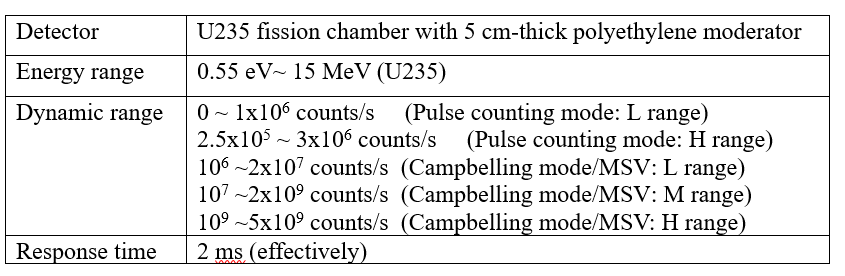
Table 1 shows the specification of the neutron monitor system. It is expected that the neutron yield can evolve by 9 decades in a high performance discharge. In the current design, the system can measure 2.5×10¹⁷ neutrons/s at maximum. The U235 FC detector, which is an ionization chamber whose wall is coated by fissile material (U235), can cover this dynamic rage. The large charges generated by the fission reactions allow to use it in the Campbelling mode. An appropriate moderator is necessary since the U235 FC detector is not sensitive to high-energy neutrons, i.e. of ~2.45MeV by DD reactions and of ~14MeV by DT reactions. To detect these high-energy neutrons a 5 cm thick polyethylene moderator is used as in JT-60U. The wide dynamic rage of the FC detector will be covered by the signal process unit with the pulse counting function and the Campbelling, or mean-square-voltage (MSV), function. To cover the full range two counter units with different but overlapping ranges are used. The Campbelling function is also secured by three processing units which cover different ranges with overlaps. In addition, the pulse counting function and the Campbelling function have an overlap.